
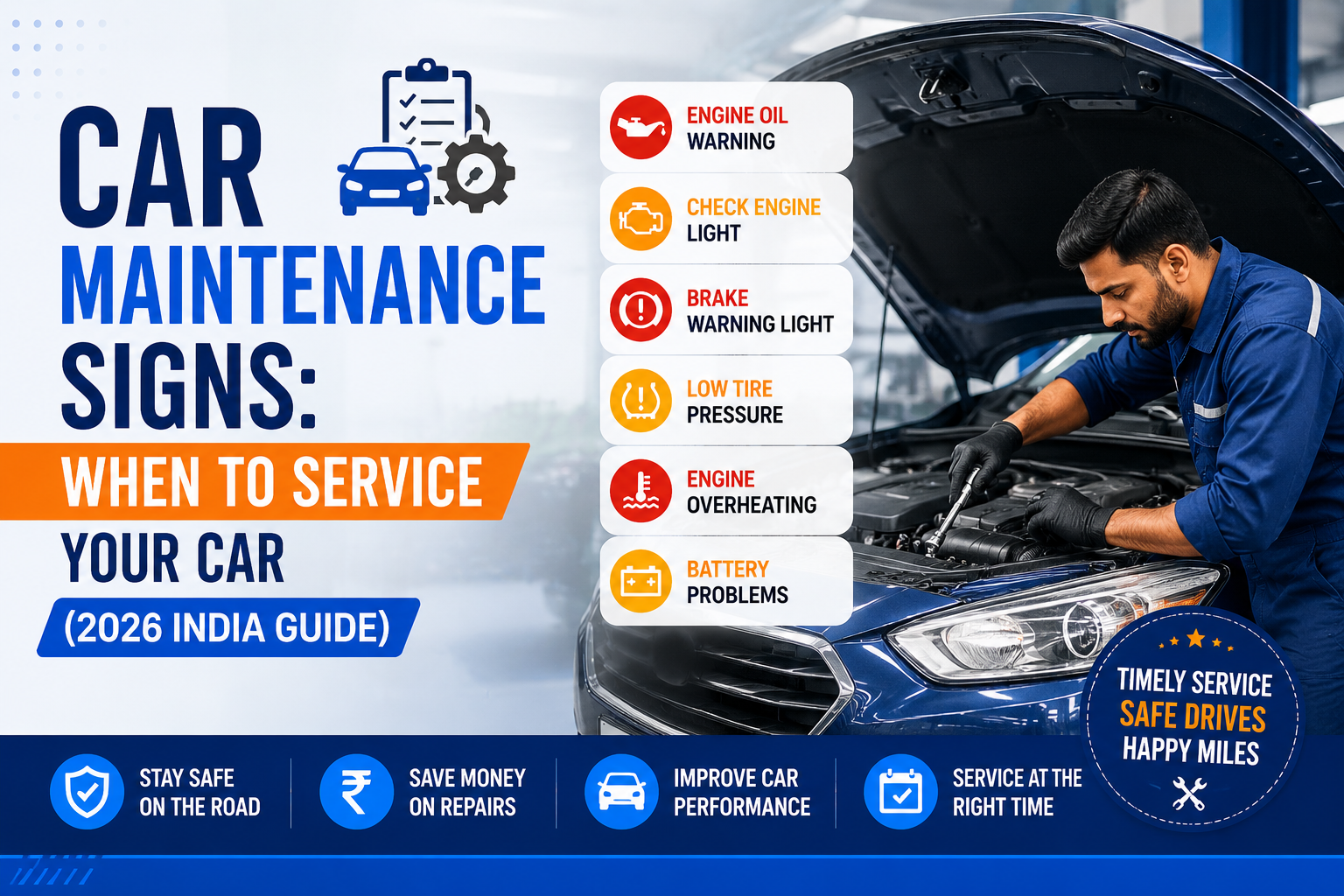
Car Maintenance Signs: When to Service Your Car (2026 India Guide)
By Dutibook
Published: July 23, 2026
Your car almost always warns you before it breaks down — you just have to know the language. Learning the common car maintenance signs, from a glowing dashboard light to a strange squeal at the traffic signal, is what separates a cheap early fix from a costly roadside breakdown. On India's dusty roads, stop-and-go traffic, and extreme heat, those signs show up sooner than the owner's manual suggests.
This guide walks you through every warning your car gives — lights, sounds, performance drops, leaks, and braking issues — plus exactly when to service your car and what it typically costs in India. By the end, you'll know which signs your car needs servicing can wait, and which mean "stop and call a mechanic today."
What Are the Most Common Car Maintenance Signs?
The most common car maintenance signs are dashboard warning lights, unusual noises like squealing or grinding, reduced performance or fuel efficiency, fluid leaks under the car, and changes in braking. Any one of these means your car needs a professional inspection before the problem grows into an expensive repair.
Think of these as your car's early-warning system. Catching them early keeps you safe, protects fuel efficiency, and avoids the kind of damage that turns a ₹2,000 fix into a ₹20,000 one.
1. Dashboard Warning Lights: Your Car's First Language
Modern cars run onboard diagnostics that constantly monitor the engine, brakes, and other systems. When something's wrong, a dashboard light switches on. Ignoring it is like ignoring a doctor's warning — the longer you wait, the worse it gets. Here's what the key lights mean:
- Check Engine Light: Can mean anything from a loose fuel cap to a serious engine fault. It may not be an emergency, but never ignore it — a quick diagnostic scan pinpoints the cause.
- Oil Pressure Light (red): Low oil pressure. This is critical — pull over safely and check your oil. Driving on low oil can destroy the engine within minutes.
- Battery Light: Usually a charging-system problem (failing alternator or loose cable), not just a dead battery. Left alone, your car will eventually stall.
- Brake Warning Light: Low brake fluid, worn pads, or an ABS fault. Because brakes are pure safety, this demands immediate attention.
- TPMS (Tyre Pressure) Light: One or more tyres are low. Correct pressure protects safety, mileage, and tyre life — inflate to the recommended level.
- Temperature Light (red): Your engine is overheating, often from low coolant or a faulty thermostat. Overheating can cause permanent engine damage.
2. Unusual Noises: When Your Car Starts Talking
A healthy car runs with a certain mechanical harmony. Any new sound is often the first clue something's wrong. Learn to read them:
- Squealing brakes: A high-pitched squeal usually means worn brake pads. Ignore it and you'll hear grinding — metal on metal — which damages the rotors.
- Grinding during gear shifts: Points to transmission, clutch, or differential trouble. Get it inspected quickly.
- Knocking or tapping from the engine: Often relates to connecting rods, valves, or low oil pressure. Can also mean wrong-octane fuel.
- Whining or humming: Commonly the power-steering pump (low fluid), wheel bearings, or differential.
- Hissing: Usually a vacuum leak, a leaking hose, or an overheating engine — watch for steam or a burning smell.
- Rapid clicking when starting: Typically a weak or dead battery; a single click can mean a faulty starter motor.
3. Performance Drops: Subtle Signs Your Car Needs Servicing
Some signs your car needs servicing are gradual, which makes them easy to miss. Watch for these shifts in how the car drives:
- Sluggish acceleration: Often a clogged air or fuel filter, worn spark plugs, or fuel-injection issues.
- Falling fuel efficiency: A drop in mileage can point to a faulty oxygen sensor, dirty injectors, low tyre pressure, or a misfiring engine.
- Stalling or rough idling: Usually the ignition system, fuel delivery, or sensors — and a safety risk in traffic.
- Vibrations or shaking: Felt through the steering or seat, this suggests unbalanced tyres, misaligned wheels, or worn suspension.
- Pulling to one side: Often wheel misalignment, uneven tyre wear, or a braking problem.
4. Fluid Leaks and Burning Smells
Your car depends on several fluids. A puddle or an odd smell is a direct signal something needs attention. Use the colour and smell to narrow it down:
|
Sign |
Likely Meaning |
Urgency |
|
Clear water |
AC condensation — normal |
None |
|
Green / orange fluid |
Coolant leak |
High — overheating risk |
|
Brown / black oily fluid |
Engine oil leak |
High |
|
Reddish fluid |
Transmission or power-steering fluid |
Medium–High |
|
Clear oily fluid near wheels |
Brake fluid leak |
Critical — brake failure risk |
|
Sweet, maple-syrup smell |
Coolant leak |
High |
|
Rotten-egg / sulphur smell |
Catalytic converter issue |
High |
A burning-rubber smell can mean a slipping belt or a hose touching hot parts; burning oil often shows as blue exhaust smoke. Don't wait these out.
5. Braking Problems: Never Ignore These
Your brakes are the most important safety system in the car. Any change in how they feel needs same-day attention:
- Spongy or soft pedal: Air in the brake lines, low fluid, or a master-cylinder fault.
- Hard pedal: Often a brake-booster problem.
- Vibration when braking: Usually warped rotors reducing braking power.
- Pulling to one side when braking: A seized caliper or unevenly worn pads.
- Longer stopping distance: A clear sign your brakes need inspection now.
When Should You Service Your Car in India?
Most manufacturers recommend servicing every 10,000–15,000 km or once a year, whichever comes first. But Indian driving conditions — dust, heat, and heavy traffic — are harder on a car, so many experts advise servicing every 6 months or 5,000–7,500 km for city driving. Diesel and CNG cars usually need shorter intervals.
Here's a realistic 2026 cost guide for a normal periodic service at a multi-brand garage in India, so you know what to expect:
|
Service Type |
What's Included |
Typical Cost (2026) |
|
Basic service |
Engine oil, oil filter, air-filter check, fluid top-ups, brake check |
₹2,400 – ₹4,500 |
|
Standard service |
Above + brake fluid, spark plugs, AC gas check, wheel balancing |
₹4,500 – ₹8,000 |
|
Major service |
Above + coolant, transmission oil, brake-pad replacement if needed |
₹8,500 – ₹18,000 |
|
Brake-pad replacement |
Per axle, parts + labour |
₹2,000 – ₹7,000 |
Costs vary by car brand, city, and parts used. Diesel cars typically cost 20–30% more than petrol. Always ask for a parts-and-labour split before approving work.
Essential Car Maintenance Tips to Prevent Problems
Spotting warning signs is reactive. These car maintenance tips help you avoid trouble in the first place:
- Follow the service schedule: Stick to the intervals in your owner's manual, adjusted shorter for Indian city conditions.
- Change engine oil on time: Oil is the engine's lifeblood — fresh oil means proper lubrication and cooling.
- Check fluid levels monthly: Engine oil, coolant, brake fluid, power steering, and washer fluid.
- Care for your tyres: Maintain correct pressure, rotate regularly, and watch for uneven wear.
- Inspect brakes periodically: Check pad wear, rotor condition, and fluid level before they fail.
- Replace filters: Air, cabin, and fuel filters keep performance and cabin air clean.
- Watch battery health: Check terminals for corrosion, especially before seasonal changes.
Noticed Any of These Signs? Book a Verified Car Mechanic on DutiBook
If your car is showing any of these warning signs, don't wait for a breakdown. On DutiBook you can book a background-verified car mechanic near you, choose a fixed price or post your job for competitive bids, and pay securely only once the work is done to your satisfaction. It's the same trusted, transparent approach DutiBook brings to every home and vehicle service.
Book a car mechanic through DutiBook and get expert help — fast, fair, and hassle-free.
Final Thoughts: Keep Your Car Running Smoothly
Being a responsible car owner means paying attention to the car maintenance signs your vehicle gives you — the warning lights, the odd noises, the drop in performance, the leaks, and the braking changes. Catch them early and you'll stay safe, spend less, and keep your car running reliably on Indian roads.
Combine that awareness with regular servicing and simple upkeep, and most costly breakdowns become avoidable. And when a sign does appear, book a verified car mechanic on DutiBook to get expert help quickly, at a price you choose.
Frequently Asked Questions
The main signs are dashboard warning lights, unusual noises like squealing or grinding, reduced acceleration or fuel efficiency, fluid leaks under the car, burning smells, and changes in how the brakes feel. Any of these means you should get a professional inspection soon.
Most manufacturers advise every 10,000–15,000 km or once a year, whichever comes first. Because of dust, heat, and traffic, many Indian city drivers benefit from servicing every 6 months or 5,000–7,500 km. Diesel and CNG cars usually need shorter intervals.
A steady check engine light often isn't an emergency, but it should be scanned soon. A flashing check engine light signals a serious problem — reduce speed and get the car inspected immediately to avoid engine damage.
A high-pitched squeal when braking usually means the brake pads are worn and nearing replacement. If ignored, you'll hear grinding, which is metal-on-metal contact that damages the rotors and raises repair costs. Get the pads checked promptly.
A normal periodic service at a multi-brand garage typically costs around ₹2,400–₹4,500 for a hatchback and more for sedans and SUVs. Bigger services with spark plugs, brake fluid, and wheel balancing cost more. Diesel cars generally cost 20–30% more than petrol.