
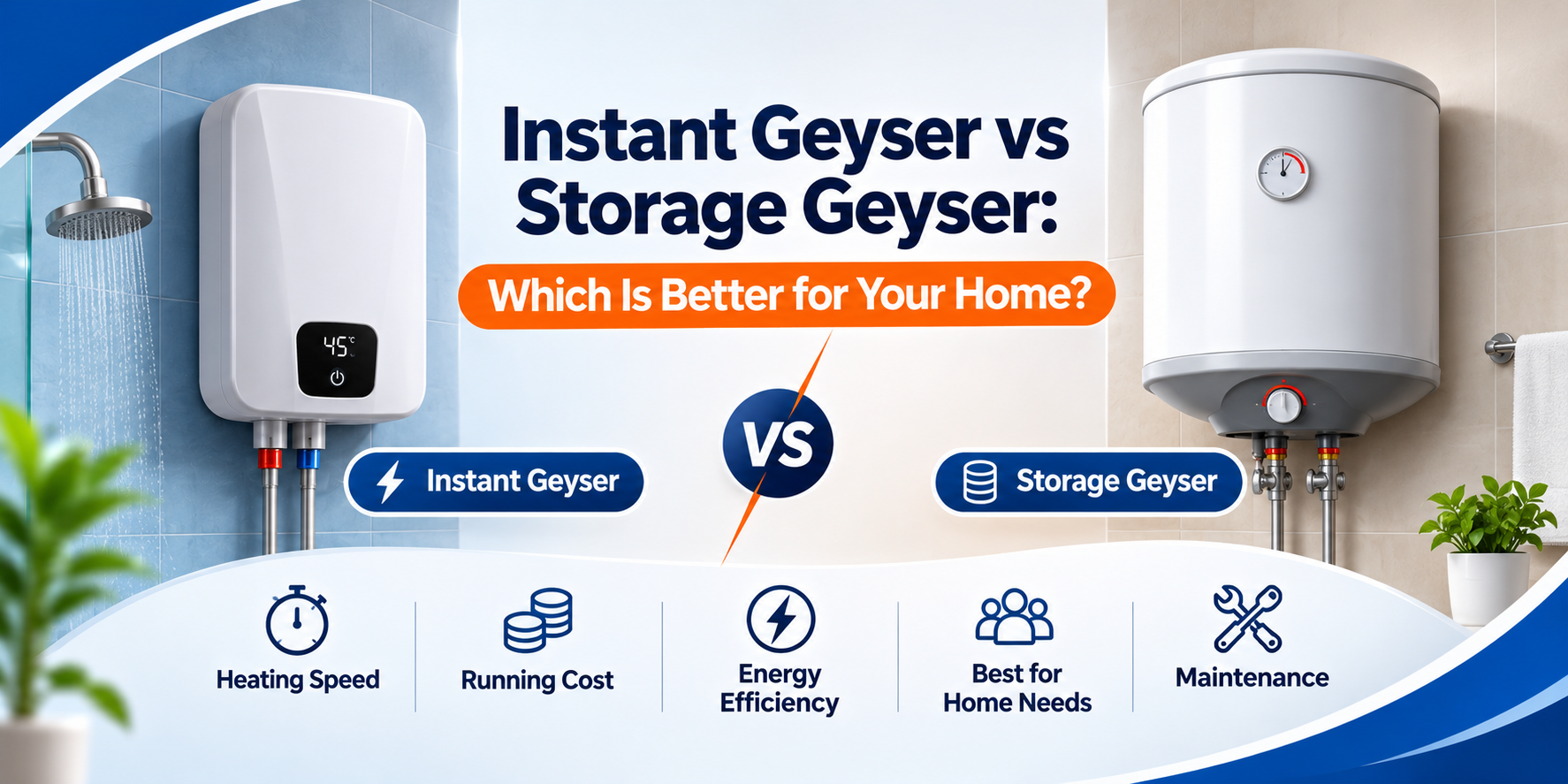
Instant Geyser vs Storage Geyser: Which Is Better for Your Home?
By Dutibook
Published: November 02, 2026
DutiBook Geyser Comparison Blog
SEO title: Instant Geyser vs Storage Geyser: Which Is Better?
Meta description: Compare instant geyser vs storage geyser for bathrooms and kitchens. Understand capacity, electricity use, winter performance and installation before buying.
Suggested slug: instant-geyser-vs-storage-geyser
Instant Geyser vs Storage Geyser: Which Is Better for Your Home?
Choosing between an instant geyser vs storage geyser starts with one practical question: how much hot water do you need at one time? A kitchen sink used briefly has different requirements from a bathroom shared by a family on a winter morning.
For homeowners and tenants in Gurgaon, Noida and Delhi NCR, inlet water temperature, shower habits and the existing electrical connection also affect the decision. Buying only by tank size or wattage can leave you with disappointing performance.
Quick answer
A small instant geyser generally suits short kitchen tasks and limited hot-water needs. A correctly sized storage geyser is usually the more practical choice for showers and repeated bathroom use. Neither type automatically uses less electricity: consumption depends on water volume, temperature rise, heat losses and operating habits.
What is the difference between instant and storage geyser models?
An instant geyser sold in India may contain a small tank. It is not necessarily a tankless heater that heats flowing water continuously. For example, A. O. Smith lists its InstaPod instant model with 3-litre and 5-litre capacities and a 3,000-watt element. [1]
A storage geyser heats a larger tank of water and uses insulation to retain heat. Its thermostat controls heating around the selected temperature. Once you draw hot water, incoming cold water gradually reduces the available temperature, and the heater needs recovery time.
A true tankless electric heater is a separate option. Its useful output depends on electrical power, inlet temperature and flow rate. Always read the specifications rather than relying on the word “instant”.
Instant geyser vs storage geyser comparison
|
Buying factor |
Small-tank instant geyser |
Storage geyser |
|---|---|---|
|
Suitable use |
Brief sink use and small draws |
Bathing and larger draws |
|
Hot-water reserve |
Limited by its small tank |
Larger heated reserve |
|
Initial heating |
Shorter for a small volume |
Longer for a larger volume |
|
Shower performance |
Can become inadequate as stored heat runs out |
More useful reserve when correctly sized |
|
Electricity use |
Depends on heating demand and losses |
Depends on heating demand and losses |
|
Space required |
Compact body |
More mounting space and load capacity |
|
Selection priority |
Usable output and electrical load |
Capacity, recovery and insulation |
|
Pressure suitability |
Check the individual model |
Check the individual model |
These are practical comparisons, not universal specifications. Two products within the same category can have different power ratings, pressure limits and installation requirements.
Which geyser is better for bathrooms and kitchens?
For a kitchen used for handwashing or occasional utensil rinsing, a compact instant geyser can be sufficient. Place it near the outlet where the manufacturer's installation rules allow; long pipe runs delay delivery and waste the water already sitting in the pipe.
For a bathroom, start with your bathing method. A measured bucket bath can use less water than a long shower, while a rain shower may require substantially more. A. O. Smith's capacity guide identifies 15-litre and 25-litre models for normal showers, with larger options for higher-demand shower systems. Treat this as a starting point, not a household guarantee. [2]
For a family sharing one bathroom, consider how closely baths follow one another. A larger reserve or time between uses may be necessary. Family size alone cannot tell you the right capacity.
For a rented flat, obtain the owner's approval before changing mounting points, plumbing or wiring. A compact appliance still needs a suitable electrical installation.
Which type consumes less electricity?
The amount of water heated and its temperature rise matter more than the product category alone. Power in kilowatts, or kW, describes how quickly a heater draws electrical energy. Energy in kilowatt-hours, or kWh, is what the electricity meter records. One kWh is one electricity unit.
For illustration, a 3 kW element running continuously for 10 minutes uses 0.5 kWh. A 2 kW element running continuously for 15 minutes also uses 0.5 kWh. These examples compare energy use, not identical real-world bathing performance.
Heating 15 litres from 20°C to 60°C requires approximately 0.70 kWh of thermal energy. This calculation uses water's heat capacity and excludes tank, pipe and other losses. Actual electricity consumption will be higher.
A storage tank also loses heat to its surroundings while holding hot water. Reheating replaces that lost heat. A small-tank instant heater can also lose stored heat; “instant” does not mean zero standby loss.
For a fair comparison, consider the same usable hot-water quantity and temperature. Then compare insulation, operating schedules and actual consumption. A lower wattage does not automatically mean a lower bill.
How should you read the BEE label?
For a storage geyser, check the Bureau of Energy Efficiency, or BEE, label and the applicable label period. BEE's storage-water-heater framework evaluates standing loss: energy used to maintain stored water under specified test conditions without drawing water. [3]
Compare models of similar capacity and the same applicable label period. Read the standing-loss figure as well as the stars. A label is useful for comparing heat retention; it does not predict your total monthly bill or make a larger tank the right size for your home.
What changes during Delhi NCR winters?
Colder inlet water increases the energy needed to reach the same outlet temperature. It also reduces how much comfortable bathing water you can obtain by mixing stored hot water with cold water.
Consider an illustrative 15-litre tank holding water at 60°C. With incoming water at 15°C and a desired mixed temperature of 40°C, ideal mixing gives about 27 litres. With incoming water at 25°C, the same calculation gives about 35 litres.
These are theoretical estimates assuming a uniform tank temperature, perfect mixing and no losses or reheating. They are not guaranteed output figures or recommended thermostat settings. Actual delivery depends on tank design, draw-off rate and temperature control.
This explains why a heater that feels adequate in milder weather may struggle during colder mornings. Choose for your demanding season and routine rather than occasional light use.
How long does a geyser take to heat water?
Heating time depends on water volume, element power and temperature rise. The approximate ideal calculation is:
Heating time in minutes = litres × temperature rise in °C × 0.0698 ÷ power in kW.
For a 40°C rise, 3 litres heated by a 3 kW element take about 2.8 minutes in theory. Heating 15 litres with a 2 kW element takes about 21 minutes. Real performance varies with losses, voltage, controls and the temperature already inside the tank.
A small tank heats quickly because there is less water to heat. That does not mean it can keep up with a high-flow shower indefinitely. Check the manufacturer's recovery information and temperature conditions before buying.
What should you check before installation?
Both types need an installation matched to their electrical load, water pressure and mounting requirements. Have a qualified installer assess:
- A dedicated electrical circuit with suitable wiring, connections and overcurrent protection.
- Effective earthing and appropriate residual-current protection, such as a residual current circuit breaker, or RCCB.
- The model's pressure rating against the actual supply, including booster-pump conditions.
- Wall strength, installation orientation and access for servicing.
- Required safety valves and the correct discharge arrangement.
Manufacturer manuals specify model-dependent electrical requirements. A. O. Smith's ZIP manual, for example, calls for a separate circuit and reliable earthing. Do not copy its component ratings to a different heater. [4]
High-rise suitability depends on measured pressure, not the floor number alone. Avoid extension boards or improvised connections. The installer should commission the unit according to its manual, including filling requirements before energising tank-type heaters.
Does hard water affect both types?
Yes. Where the supply is hard, minerals can form scale inside the tank and on the heating element. A. O. Smith identifies these deposits as a potential cause of reduced heater performance. [2]
Water quality varies between buildings and supply sources, including within Gurgaon and Noida. Check your actual supply rather than assuming every NCR home has identical conditions. Discuss suitable tank protection, element design and maintenance with the installer.
Follow the model's service schedule, adjusted for water conditions and use. Descaling and internal electrical checks need appropriate professional handling. DutiBook's water heater maintenance guide explains maintenance considerations for Indian homes.
What should your budget include?
Compare the complete installed cost, including mounting accessories, plumbing changes, electrical work and any necessary pressure management. Also consider servicing, replacement parts and electricity use over time.
A low purchase price can be poor value if the heater cannot meet your bathing needs. Conversely, paying for a much larger tank adds space requirements and may increase unnecessary heat retention losses. Ask for an itemised installation estimate before deciding.
Choose around your daily routine.
Choose a compact instant model for small, brief draws and a suitably sized storage model for larger bathroom demand. Check winter performance, wiring, pressure and maintenance before finalising either option.
Need help with geyser installation, servicing or repair? Visit DutiBook and check the available services for your location. Share your current heater details, bathing routine and installation concerns so the scope of work can be assessed.
Frequently Asked Questions
A storage model is usually more practical for shared bathroom use. Select capacity around bathing method, consecutive users, inlet temperature and recovery time. A small instant model can still serve a separate kitchen.
Can a 3-litre instant geyser run a shower continuously?
Can a 3-litre instant geyser run a shower continuously?
A thermostat stops the heating element once its control temperature is reached. If power remains available, the element may cycle on again as stored water cools. Electronic controls may also consume some power.
Possibly, after checking usable output, electrical load, pressure and mounting compatibility. A smaller appliance does not automatically work with the existing circuit or meet the same hot-water demand.