
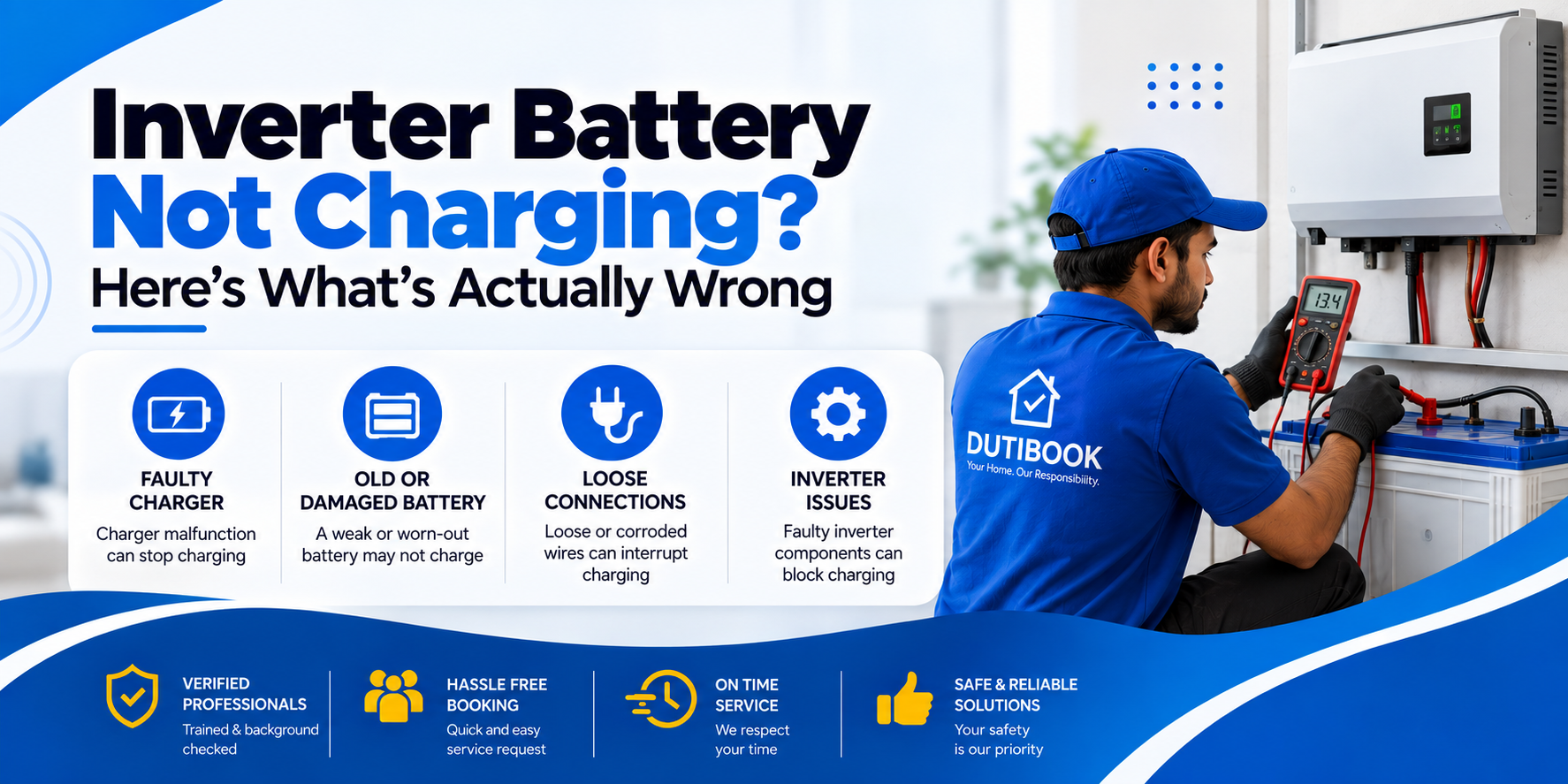
Inverter Battery Not Charging? Here's What's Actually Wrong
By Dutibook
Published: September 24, 2026
Quick Answer
If your inverter battery is not charging, the most common cause — by far — is a low or dry water level in the battery cells, which is easy to check and fix yourself with distilled water. Other common causes include corroded terminals, sulphation (lead deposits on the plates from prolonged undercharging), a blown fuse, or a failing charging circuit. If you recently topped up the water and it's still not charging properly, the underlying issue may be something water alone can't fix — like an old battery or a charger problem. Here's how to tell the difference.
The One Thing Most People Get Wrong About "Charging Complete"
Before troubleshooting, understand this: your inverter's charging light measures voltage, not how much energy is actually stored. A healthy battery takes hours to climb to full voltage as it genuinely fills up. A worn-out battery, whose plates can no longer hold charge properly, can shoot up to that same voltage in minutes — because there's almost nothing left inside to store. The inverter sees "full voltage" and shows a charged indicator, even though the battery is nowhere near actually full.
This is why a battery can show "fully charged" and still give you only 10-15 minutes of backup. The charging light tells you the voltage; your actual backup time tells you the truth.
Inverter Battery Charging Problem: The Most Common Causes
1. Low or Dry Water Level (Most Common by Far)
For lead-acid and tubular batteries — the most common type in Indian homes — water inside the cells evaporates over time, especially during charging and hot weather. When the level drops too low, the lead plates get exposed to air, which damages them and disrupts charging.
How often to check, based on Indian conditions:
|
Season |
Recommended Check Frequency |
|---|---|
|
Summer (April-June) |
Every 45-60 days |
|
Monsoon |
Every 60-75 days |
|
Winter |
Every 90 days |
|
Hot cities (Delhi, Rajasthan, interior Maharashtra) |
Check more frequently — evaporation is faster |
2. Corroded or Loose Terminals
A white or greenish crust on the battery terminals blocks proper electrical contact, which can prevent charging even if everything else is fine.
3. Sulphation
When a battery is left undercharged or discharged for too long, lead sulphate crystals build up on the internal plates. This coating blocks the chemical reaction the battery needs to charge and hold power — and if it's severe, it can make the battery unable to charge properly no matter how long it's connected.
4. Charging Circuit or ICU Issues
The inverter's charging circuit (sometimes called the ICU — Intelligent Charging Unit) controls how power flows into the battery. A fault here can mean the battery itself is fine, but it's simply not receiving proper charging current.
5. Blown Fuse
Many inverters have a fuse specifically for the charging circuit. If this has blown, the battery won't charge even though the rest of the inverter works normally.
6. Battery Age
Lead-acid batteries typically last 3-5 years with proper maintenance. Beyond that, declining capacity is often a sign it's simply time for a replacement, not a repair.
Inverter Battery Not Charging After Water Filling: What This Usually Means
If you've just topped up the water and charging still isn't working properly, a few things could be going on:
-
The underlying problem wasn't actually low water — if sulphation, a blown fuse, or a charger fault is the real cause, adding water won't fix it, since the water level wasn't the actual issue
-
Water was added incorrectly — filling while the battery was very hot, or overfilling past the recommended mark, can cause temporary heating or overflow issues during the next charge cycle
-
The battery needs time to stabilize — after a top-up, it can take one full charge cycle before performance visibly improves, especially if the water was low for a while before you noticed
-
The battery may already be too damaged — if plates were exposed to air for an extended period before you topped up, some permanent damage may already be done
How to Safely Check and Top Up Inverter Battery Water
-
Turn off and disconnect the inverter/battery before opening the caps, for safety
-
Wear gloves and, ideally, eye protection — battery acid is corrosive
-
Open each cell cap carefully and check that the electrolyte covers the plates
-
Use only distilled water — never tap water, RO water, or packaged drinking water. Minerals in other water types damage the plates permanently and can reduce battery life by 40-60%
-
Pour slowly, filling only to the marked maximum level — never to the brim, since electrolyte expands during charging and can overflow
-
Close the caps firmly, wipe any spills, and reconnect the battery to charge
Important safety note: Batteries produce hydrogen gas while charging, which is explosive in enclosed spaces. Always ensure the battery area is well-ventilated, and never bring an open flame or spark near it — including while topping up water.
Inverter Battery Charging Issue: A Quick Self-Check Before Calling for Help
|
Check |
What It Tells You |
|---|---|
|
Is the water level visibly low? |
If yes, top up first — this alone fixes most cases |
|
Are terminals clean, tight, and free of corrosion? |
If corroded, this needs cleaning before charging will work properly |
|
Is the inverter's fuse intact? |
A blown fuse means no charging current reaches the battery at all |
|
Is the battery older than 4-5 years? |
Age-related capacity loss may need replacement, not repair |
|
Does backup time not match the "full charge" indicator? |
This often points to sulphation or a genuinely worn-out battery |
Inverter Battery Not Charging Properly: When It's More Than a Quick Fix
Some issues are safe and simple to handle yourself — water top-ups and checking for an obvious blown fuse. Others need a professional:
-
Persistent sulphation — this sometimes requires specialised cleaning or a desulphation process best left to a technician
-
Charging circuit (ICU) faults — diagnosing internal inverter electronics needs proper testing equipment
-
Uncertain battery health — a technician can load-test the battery to confirm whether it's actually failing versus a simpler fix
-
Repeated water loss in one specific cell — this can indicate an internal battery fault needing professional inspection
Preventing Future Charging Problems
-
Check water levels on the seasonal schedule above, rather than waiting for a problem to appear
-
Keep terminals clean and lightly greased to prevent corrosion
-
Avoid letting the battery sit fully discharged for extended periods, which accelerates sulphation
-
Get an annual inverter and battery health check, especially before peak summer power-cut season
Need Help Diagnosing an Inverter Battery Problem?
If water top-ups and basic checks haven't fixed your inverter battery charging issue, it's time for a proper diagnosis. DutiBook connects you with verified electricians and inverter repair experts in Gurgaon who can test your battery, charger, and wiring safely and accurately.
Disclaimer: This article is for general guidance only. Battery acid and hydrogen gas produced during charging pose real safety risks — always disconnect power before servicing, use protective gear, and consult a professional if you're unsure.
Frequently Asked Questions
The most common cause is low water level in the battery cells, followed by corroded terminals, sulphation from prolonged undercharging, a blown charging fuse, or a fault in the inverter's charging circuit.
This usually means the low water level wasn't the actual root cause — a fuse, charging circuit fault, or sulphation may be the real issue — or the battery needs a full charge cycle to show improvement after the top-up.
A common sign is the battery showing "fully charged" quickly but delivering very poor backup time — since sulphated plates struggle to hold a genuine charge even though voltage rises fast.
Only distilled water. Tap water, RO water, or packaged drinking water contain minerals that damage the battery plates permanently and can significantly shorten battery life
Roughly every 45-60 days in summer, 60-75 days during monsoon, and every 90 days in winter — more frequently in hot cities where water evaporates faster.
Yes, especially if the battery is more than 3-5 years old, shows poor backup despite a full charge indicator, or has cells that repeatedly lose water faster than others — these often point to a battery nearing the end of its life.