
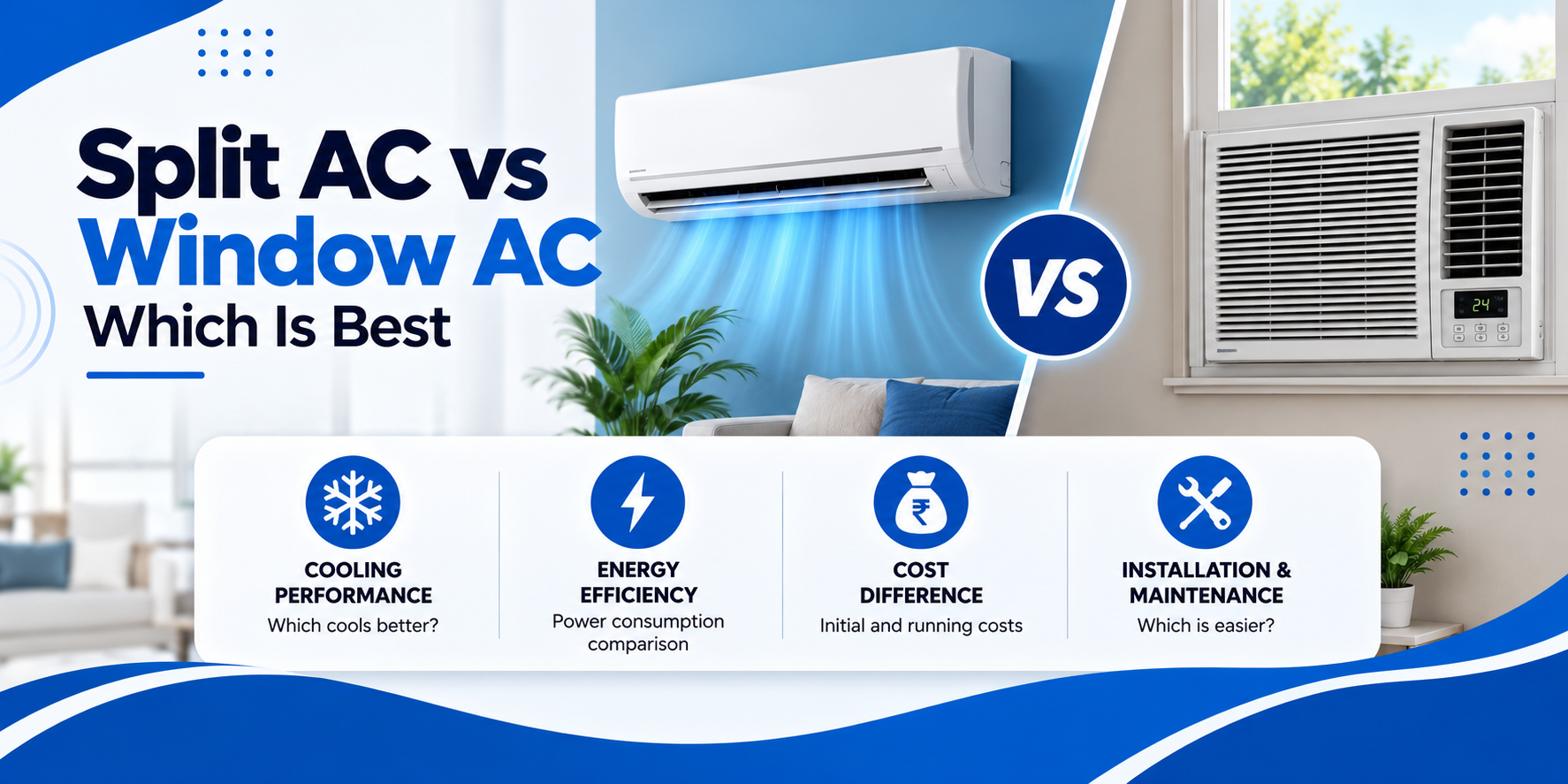
Split AC vs Window AC: Which Is Best for Your Home in 2026?
By Dutibook
Published: September 24, 2026
Introduction
Buying an air conditioner in India is a decision most families make once every 8-10 years — and with two very different designs on the market, it's easy to get stuck comparing specs without a clear answer. The split AC vs window AC question comes down to a few real, measurable factors: how much electricity each one uses, how much they cost upfront, how well they cool a room, and how easy they are to install in your specific home. This guide breaks down all of it, using real numbers, so you can decide with confidence rather than guesswork.
Quick Answer
Split AC is generally the better choice for most Indian homes — it uses less electricity (thanks to inverter compressor technology), cools a room more evenly, and runs quieter, since its compressor sits outside. Window AC remains the better choice if you're renting, have a tight budget, or need to cool a small room occasionally — it costs less upfront and is easier to move or uninstall. The right answer genuinely depends on your room size, how many hours a day you'll run it, and whether you own or rent your home.
What Is a Split AC?
A split AC has two separate units: an indoor unit that blows cool air into the room, and an outdoor unit (housing the compressor and condenser) that sits outside, connected by refrigerant piping and wiring. This separation is what gives split ACs their key advantages — quieter indoor operation and better heat dissipation outside.
What Is a Window AC?
A window AC packs everything — compressor, condenser, and evaporator — into a single box that fits into a window or a wall opening. It's a simpler, more compact design, which is exactly why it tends to cost less and install faster.
Which Consumes More Electricity: Split or Window AC?
This is the question that matters most for your monthly budget, and the data is fairly consistent across sources: window ACs generally consume 20-30% more electricity than split ACs of the same cooling capacity.
Here's why: most windows ACs use fixed-speed, non-inverter compressors that run at full power until the room reaches the set temperature, then switch off completely — and restart at full power again once the room warms up. This start-stop cycle uses more electricity over time. Split ACs, especially inverter models, adjust compressor speed continuously based on cooling need, avoiding this repeated full-power restart.
A real cost example (1.5-ton AC, 8 hours daily use, ₹7 per unit):
|
AC Type |
Rated Power Draw |
Daily Units Used |
Monthly Cost |
|---|---|---|---|
|
5-star inverter split AC |
~840 W |
~6.7 units |
~₹1,410 |
|
3-star window AC |
~1,550 W |
~12.4 units |
~₹2,600 |
That's a difference of roughly ₹1,200 per month, or close to ₹9,600 over an 8-month cooling season — enough to cover the higher upfront price of a split AC within a single heavy-use year.
Note: Exact figures vary by brand, model, and local electricity tariff — always check the specific ISEER rating and BEE star label of the model you're buying.
Understanding ISEER: The Number That Actually Matters
ISEER (Indian Seasonal Energy Efficiency Ratio) is printed on every BEE (Bureau of Energy Efficiency) star label, right next to the model's annual electricity consumption. The higher the ISEER, the more efficient the AC.
-
Window ACs typically top out around 3.6 ISEER
-
5-star inverter split ACs reach 4.5 to 5.2 ISEER
A 5-star AC can use up to 10% less energy than a 4-star AC of the same type — so within either category, always compare star ratings, not just split vs. window.
Split AC vs Window AC: Full Comparison Table
|
Factor |
Split AC |
Window AC |
|---|---|---|
|
Electricity use |
Lower (especially inverter models) |
20-30% higher on average |
|
Upfront price |
Higher (₹8,000-10,000 more, typically) |
Lower |
|
Installation |
Needs professional installation, outdoor unit space |
Simpler, needs a window/wall opening |
|
Noise level |
Quieter indoors (compressor is outside) |
Louder (compressor is inside the room) |
|
Cooling spread |
Even, throws air 30+ ft with wide swing |
Direct blast; far corners may stay warmer |
|
Best for room size |
Medium to large rooms |
Small rooms (up to ~150 sq. ft.) |
|
Renting suitability |
Less flexible — semi-permanent install |
Easier to move/uninstall |
|
Maintenance |
Slightly more (two units to service) |
Simpler (single unit) |
Which Is Better for Cooling Performance?
Split ACs generally cool more evenly because the indoor unit throws air across a wider angle and greater distance. A window AC blows air in one direction — in a larger or oddly shaped room, the corner farthest from the unit can stay noticeably warmer.
For a small, squarish room (like a single bedroom), this difference matters less. For a larger living room, a split AC's wider air throw makes a real, noticeable difference in comfort.
Installation: What to Actually Expect
Window AC installation requires a compatible window or wall opening of the right size — generally quicker and doesn't always need a specialist, though professional installation is still recommended for safety and proper sealing.
Split AC installation requires:
-
Wall space for the indoor unit
-
Outdoor space for the compressor unit
-
Refrigerant piping between the two, which needs proper vacuuming and charging — this must be done by a trained technician
If you're in a rented apartment without an existing AC-compatible window, a split AC may actually be easier to install than trying to retrofit a window unit into a wall opening that doesn't exist.
Noise Comparison
Because a split AC's compressor sits outside, the indoor unit itself is significantly quieter — a real benefit for bedrooms or shared living spaces. A window AC houses everything in one box inside the room, so compressor noise is always present indoors.
Step-by-Step: How to Decide Which One You Need
-
Measure your room size. Under 150 sq. ft. → either works. Larger rooms → split AC cools more evenly.
-
Check your usage pattern. Running the AC 6+ hours daily most months → the electricity savings of a split AC add up fast.
-
Confirm your installation situation. Renting without a window opening → a split AC may actually be simpler to fit.
-
Set your budget honestly. Tight upfront budget, occasional use → window AC remains a reasonable, lower-cost choice.
-
Compare ISEER and star ratings within your chosen type — don't assume all split or all window ACs perform the same.
Benefits of Split AC
-
Lower running cost, especially with inverter technology
-
Quieter indoor operation
-
More even cooling across larger rooms
-
Sleeker, less visible design indoors
Benefits of Window AC
-
Lower upfront purchase price
-
Simpler, faster installation
-
Easier to relocate or uninstall — ideal for renters
-
Slightly simpler maintenance (single unit)
Common Mistakes When Choosing Between the Two
-
Buying based on upfront price alone, without factoring in the electricity cost difference over years of use
-
Ignoring the ISEER/star rating and assuming "split" automatically means efficient — a poorly-rated split AC can still be inefficient
-
Undersizing or oversizing tonnage for the room, which hurts efficiency regardless of AC type
-
Not checking installation feasibility before purchase, especially for split ACs in unusual room layouts
-
Skipping annual maintenance, which reduces efficiency and increases running costs over time on both types
Expert Tips
-
If your electricity bill matters more than upfront cost, a 5-star inverter split AC typically pays for its price difference within 12-18 months of regular use
-
For rental properties, ask your landlord about outdoor unit placement options for a split AC before ruling it out due to "no window"
-
Always get your AC serviced before peak summer — dirty filters and coils reduce efficiency on both split and window units significantly
Latest Trends (2026)
-
Inverter technology has become close to standard even in mid-range split ACs, narrowing the price gap with non-inverter models
-
More brands are offering 5-star window ACs with basic inverter-style compressors, slightly closing the efficiency gap between the two categories
-
Smart, app-controlled ACs (both split and window) are increasingly common, allowing usage tracking that helps identify inefficient habits
Statistics Snapshot
-
Window ACs consume 20-30% more electricity than split ACs of similar capacity (Desi Utility, 2026)
-
A 5-star split AC can save roughly ₹9,600 over an 8-month cooling season compared to a 3-star window AC (based on 2026 tariff calculations)
-
ISEER for window ACs tops out near 3.6, while 5-star split ACs reach 4.5-5.2
Case Study Example
Consider a Gurgaon household running a 1.5-ton AC for 8 hours daily across an 8-month cooling season. Switching from a 3-star window AC to a 5-star inverter split AC reduced their monthly electricity cost from roughly ₹2,600 to ₹1,410 — a saving of about ₹1,200 a month. Over the season, that's close to ₹9,600 saved, enough to offset the typical ₹8,000-10,000 price premium of the split AC within the very first year of heavy use.
Conclusion
For most Indian households, a split AC is the better long-term choice — lower electricity bills, quieter operation, and better cooling coverage typically outweigh the higher upfront cost within a year or two of regular use. But a window AC remains a genuinely sensible choice for renters, small rooms, and anyone prioritising a lower purchase price over long-term running costs. The right pick for you comes down to your room size, how often you'll run it, and whether you own or rent your home — not simply which type is "better" in the abstract.
16. Key Takeaways
-
Window ACs use 20-30% more electricity than split ACs of the same capacity
-
A 5-star inverter split AC can save ~₹1,200/month over a 3-star window AC (1.5-ton, 8 hrs/day use)
-
Split ACs cool larger rooms more evenly; window ACs suit small rooms well
-
Window ACs are easier and cheaper to install, especially for renters
-
Always compare ISEER/star ratings within a category, not just "split vs. window" in the abstract
17. Get Reliable AC Service in Gurgaon
Not sure which AC is right for your home — or need help with installation or servicing? DutiBook connects you with verified AC technicians in Gurgaon for installation, maintenance, and repairs, so you get the cooling performance you paid for.
Disclaimer: Electricity consumption and cost figures are general estimates based on typical usage patterns and 2026 tariff rates. Actual savings vary by brand, model, local electricity rates, and usage habits. Always check the BEE star label and ISEER rating of the specific model before purchase.
Frequently Asked Questions
Split AC is generally best for most homes due to lower electricity use, quieter operation, and better cooling spread. Window AC remains a solid, budget-friendly choice for small rooms or rental situations.
Window ACs typically consume 20-30% more electricity than split ACs of the same capacity, mainly because most window ACs use fixed-speed compressors rather than inverter technology.
For a small room under 150 sq. ft., a window AC can work perfectly well and costs less upfront. A split AC becomes more advantageous as room size increases.
Yes, for most households running the AC regularly — the electricity savings from a 5-star inverter split AC can offset its higher price within 12-18 months of typical use.
Yes. Split ACs don't require a window opening — they need wall space for the indoor unit and outdoor space for the compressor, which can make them easier to fit than a window AC in some homes.
Window ACs are generally easier for renters since they can be installed and removed without permanent wall modifications, unlike a split AC's semi-permanent piping and mounting.
Generally yes — a 5-star AC can use up to 10% less energy than a 4-star model of the same type. Always check the ISEER number on the BEE label for the most accurate comparison.
Both can cool effectively at the right tonnage for the room size, but split ACs tend to distribute cool air more evenly across larger or irregularly shaped rooms due to their wider air throw.
Yes. A window AC houses its compressor inside the room, making it noticeably louder than a split AC, whose compressor sits in the outdoor unit.
Based on 2026 electricity rates, a 1.5-ton 5-star split AC can save approximately ₹1,000-1,500 per month compared to a similarly sized 3-star window AC, depending on usage hours and local tariffs.